Is robot repeatability enough for close-fitting tray pockets?
A repeatability figure does not define part-to-pocket fit. Check target offset, gripping position and tray location before choosing an arm and gripper.
Read the metric beside the number
No. The UR10e datasheet updated September 2026 lists pose repeatability of ±0.05 mm per ISO 9283. That is a UR10e metric, not a CBOXTEC rating or a finished-part placement tolerance.
For the arm you are considering, ask for the exact metric, reference point and test conditions, including load and motion. An unlabeled ‘precision’ figure is insufficient for comparing models or deciding whether a part will enter a close-fitting pocket.
- Universal Robots — UR10e Technical specification (Updated September 2026) · Accessed 2026-10-14
Separate repeated returns from target offset
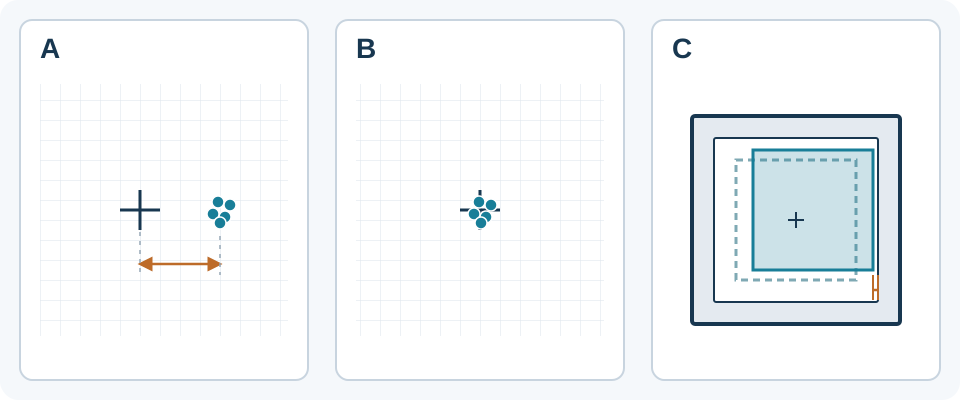
KUKA distinguishes repeatability from absolute accuracy: consistent returns differ from closeness to the intended physical target.
In a placement check, a compact group of measured positions can still sit off-center. Record the offset from the required target and the variation between repeats separately. This conceptual distinction does not supply an ISO test method or an allowable error for your application.
- KUKA — Robot Seçiminde İzlenmesi Gereken İdeal Adımlar, section 5 (undated page) · Accessed 2026-10-14
Check the held part, not only the tool point
Include possible variation in how the part seats between the fingers, pad compression and the part's own dimensions. Compare the actual grip faces and orientation with the edge that must clear the pocket. A small rotation can change clearance at an edge away from the rotation point.
Use the largest permitted part dimensions and smallest usable pocket dimensions in the fit review. Check the part position while held and after release. The arm's repeatability figure cannot replace these checks, and there is no universal clearance or error-summing rule for every part and tray.
Define where the tray is located
UR's SW5_21 Features chapter describes object-relative movements; updating the object's feature changes those related movements.
For your proposed equipment, establish how the tray is located after replacement and how pocket targets are obtained: taught individually or calculated from nominal spacing. Check representative pockets, including far corners. A good placement at the first pocket alone does not establish fit across the tray. The UR feature example does not establish a CBOXTEC controller function.
- Universal Robots — Features, PolyScope 5 manual (SW5_21) · Accessed 2026-10-14
Request evidence for the proposed part and pocket
Send the supplier dimensioned part and pocket drawings with tolerances, a grip sketch, the tray locating method, loaded tool configuration and intended motion. Ask which arm and gripper positioning information applies to that configuration and which placement checks remain necessary.
Agree on the acceptance criteria and measurement method before a sample test. A qualified application assessment should check target offset, variation and clearance using the proposed fingers, actual parts and representative pockets under the intended operating conditions. Include tray removal and replacement if they are part of routine use; record how positions were measured and the measurement uncertainty.
CBOXTEC Robotics supplies robot arms and grippers. The manufacturer examples above help interpret specifications; they do not establish CBOXTEC compatibility or placement yield. A sample placement check also does not certify installation safety.
Manufacturer references
- KUKA — Robot Seçiminde İzlenmesi Gereken İdeal Adımlar, section 5 (undated page) · Accessed 2026-10-14
- Universal Robots — UR10e Technical specification (Updated September 2026) · Accessed 2026-10-14
- Universal Robots — Features, PolyScope 5 manual (SW5_21) · Accessed 2026-10-14