Robot payload is not workpiece weight: count the gripper and adapter
Check the total carried mass, center of gravity, inertia and grip conditions before selecting a robot arm and gripper for loading, unloading or tray handling.
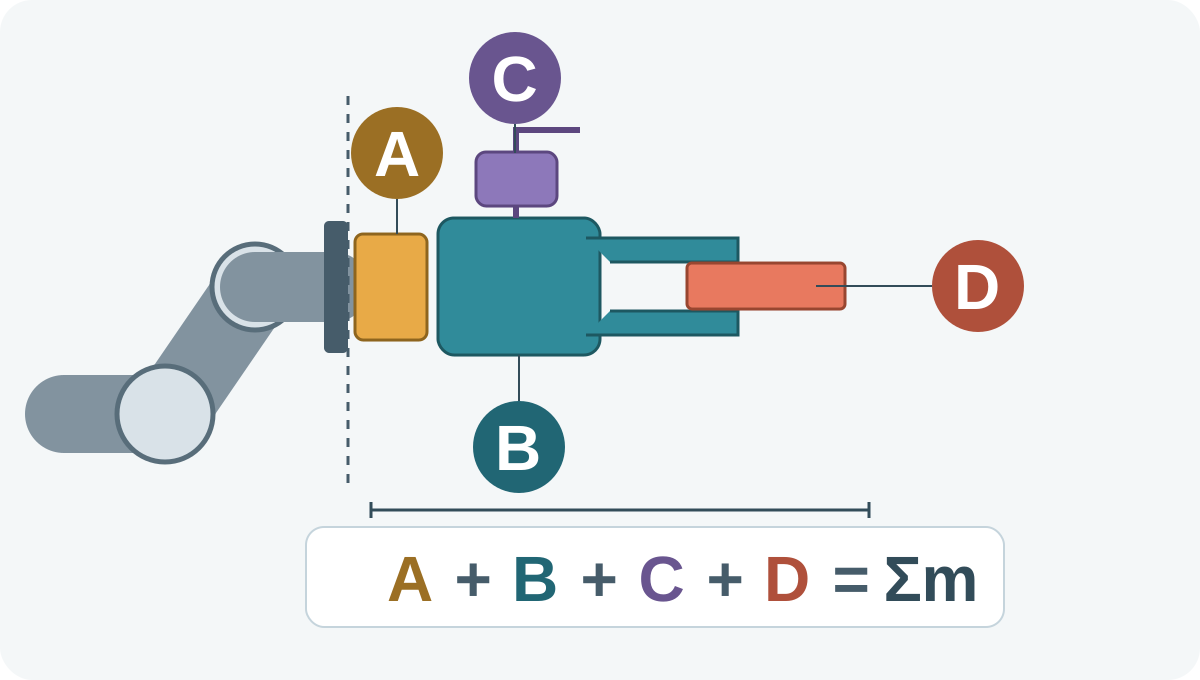
Start with the total load at the flange
The workpiece mass alone is insufficient for arm selection. Count the workpiece, gripper, adapter and other tooling carried at the flange. The robot arm's own body mass is a separate figure.
Robotiq's Robotic End Effectors - Payload vs Grip Force includes the end effector, bracket and handled object in wrist payload. This guide turns that distinction into a selection checklist; it does not specify a CBOXTEC model's limits.
Build a mass checklist for the installed configuration
Gripper: record its installed mass, including the actual fingers, pads and fittings. Check whether the manufacturer's stated mass already includes these items.
Adapter: include the flange plate, coupling, tool changer and fasteners that the arm carries. Avoid counting an included coupling twice.
Attached tooling: add carried sensors, camera mounts and other accessories. Identify the carried portions of cables and hoses; ask how their routing and external forces must be assessed.
Workpiece: record the maximum actual part mass and the number held at once, including any tray or fixture that moves with it. Keep separate records for the empty tool and each loaded configuration.
Use mass arithmetic as a first screen
For a given configuration, total carried mass equals the sum of the installed tool components and the carried workpiece. Subtracting fixed tooling mass from a quoted arm payload gives only a preliminary mass allowance.
That allowance is not an approved workpiece capacity. Verify the exact arm's load envelope and applicable operating limits. Do not adopt a universal reserve percentage or assume that a lighter part makes every pose and motion acceptable.
Check center of gravity and inertia separately
UR3e's Maximum Payload (PolyScope SW5.22) ties its rating to center-of-gravity offset. UR MotionPlus 1.5's Mass Properties documentation separates mass, center of gravity and inertia. These are manufacturer-specific references.
Request the assembly's mass distribution in the reference frame required by the selected arm. Do not substitute the tool center point for the center of gravity. Have empty and loaded configurations assessed against the applicable load chart, inertia limits and intended motion; a mass sum cannot supply those checks.
- Universal Robots — Maximum Payload (UR3e, PolyScope SW5.22) · Accessed 2026-10-10
- Universal Robots — Manipulate Coordinate Frames, Mass Properties (MotionPlus 1.5) · Accessed 2026-10-10
A gripper must retain the part during motion
A gripper's payload rating concerns the part mass it may carry (kg); gripping force describes force at the fingers (N). Read both with their stated test conditions; neither proves that the proposed part will stay held.
The Hand-E Instruction Manual, 6. Specifications (2019 web edition) distinguishes friction and form-fit grasps and discusses acceleration and stopping loads. Those Hand-E conditions are not CBOXTEC gripper specifications.
For the selected gripper, assess contact geometry, surface condition, custom fingers, part damage, motion and stopping behavior. Require application-specific retention checks and a qualified risk assessment before operation; static holding alone is insufficient.
- Robotiq — Hand-E Instruction Manual, 6. Specifications (2019 web edition) · Accessed 2026-10-10
Send the supplier the information needed for selection
Provide part drawings or photos, maximum mass, dimensions, material, oily or delicate surfaces, grasp orientation and simultaneous part count. Add the installed tooling list, known offsets, arm mounting, required reach and intended motion conditions.
Ask for the exact model and variant, official load and inertia information, gripper limits, mechanical connection details and supported electrical/control interfaces. Loading, unloading and tray handling describe applications. CBOXTEC Robotics supplies robot arms and grippers.
Reassess the whole configuration when comparing alternatives
Consider lighter tooling, a shorter adapter, a different grasp, fewer parts per pick, revised motion or a different arm/gripper rating. Treat each as a candidate to assess, rather than a guaranteed remedy; changing geometry also changes load distribution.
The UR and Robotiq references explain their own products or methods. They do not establish CBOXTEC compatibility, controller features or performance. Confirm the selected products and complete the relevant application checks before purchase and operation.
Manufacturer references
- Universal Robots — Maximum Payload (UR3e, PolyScope SW5.22) · Accessed 2026-10-10
- Universal Robots — Manipulate Coordinate Frames, Mass Properties (MotionPlus 1.5) · Accessed 2026-10-10
- Robotiq — Robotic End Effectors - Payload vs Grip Force (original 2014-01-29; updated 2025-03-06) · Accessed 2026-10-10
- Robotiq — Hand-E Instruction Manual, 6. Specifications (2019 web edition) · Accessed 2026-10-10