Does a ‘closed’ signal mean the gripper is holding a part?
Before relying on gripper feedback, distinguish finger position, contact detection and the separate question of whether the part will remain held.
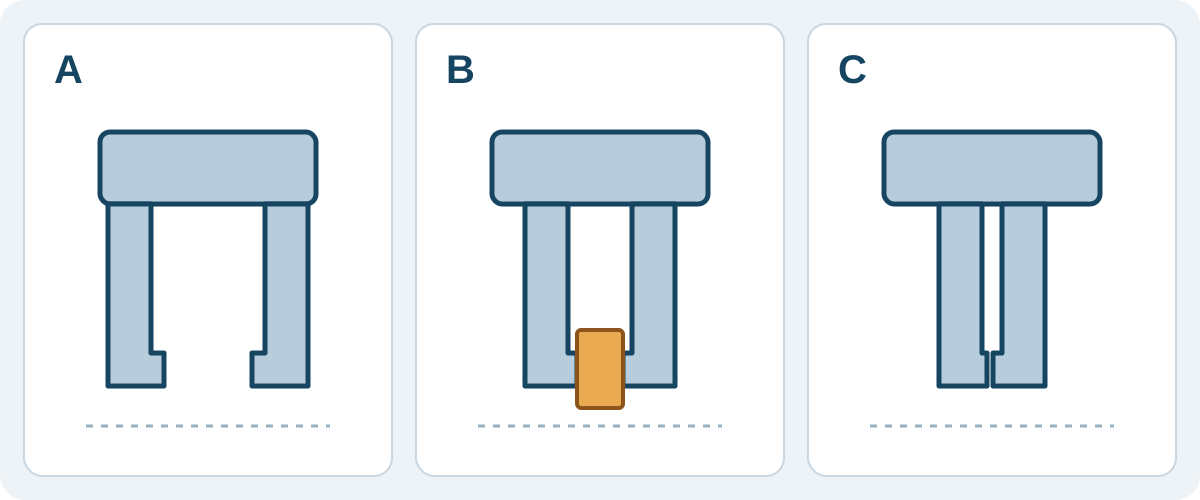
Ask what the signal actually reports
A label such as ‘closed’ is not enough to confirm that a part is held. Ask whether it reports an end position, a position selected for gripping a part, or a contact-detection status.
SMC's MHS catalog, printed pages 762–763, shows different detected positions for finger return, workpiece gripping and empty closure. The examples depend on switch quantity and position, and differ between external and internal gripping. This is an SMC example, not a description of CBOXTEC equipment.
Check the part position against empty closure
The notes on printed page 763 of the SMC catalog warn that detection near an open or closed stroke end may be limited by auto-switch hysteresis and other factors.
For a proposed part, ask the supplier to show where the fingers stop with the part and where they stop empty. Include the part's size range and proposed fingers. If those positions are close together, ask what the selected model can distinguish under those conditions; do not assume a different signal name solves the question.
Read object detection with its conditions
Robotiq's 2F-85/2F-140 manual separates actual finger position from object-detection status. The latter has a stated command-status condition; it is not an unconditional ‘part present’ flag.
The manual also warns that a thin part grasped at the fingertips can be picked up without triggering object detection. It recommends checking finger position together with object detection rather than relying on either alone. These statements apply to the documented Robotiq example; they are not universal logic for other grippers.
- Robotiq — 2F-85/2F-140 Instruction Manual, Control §§4.4 and 4.5.3 (undated HTML page) · Accessed 2026-10-16
Keep detection and retention as separate questions
Our selection advice is to request both a definition of the feedback and a separate grip assessment for the proposed part, fingers, surface condition and motion. An indication alone does not verify retention throughout that motion or establish behavior after a supply loss.
Ask which feedback the proposed model actually exposes, through which interface and under which documented model or software conditions. An interface name by itself does not explain what a status means. Any safety function needs its own evidence and assessment.
Send the supplier a requirement that can be checked
Provide a part drawing and size range, the proposed contact area and finger geometry, and the intended loading or tray-handling context. Ask for the expected feedback with a part and without a part, the documented exceptions, and the conditions for a later evaluation.
CBOXTEC supplies robot arms and grippers. Use these questions when discussing a proposed model. The loading and tray examples explain the requirement; they do not establish model suitability or the performance of an installation.